Pocket Sun & Michelle Turner
# Episode 1: The Impact Pitch Podcast
## Complete Transcript - Michelle Turner & Pocket Sun
---
## Intro
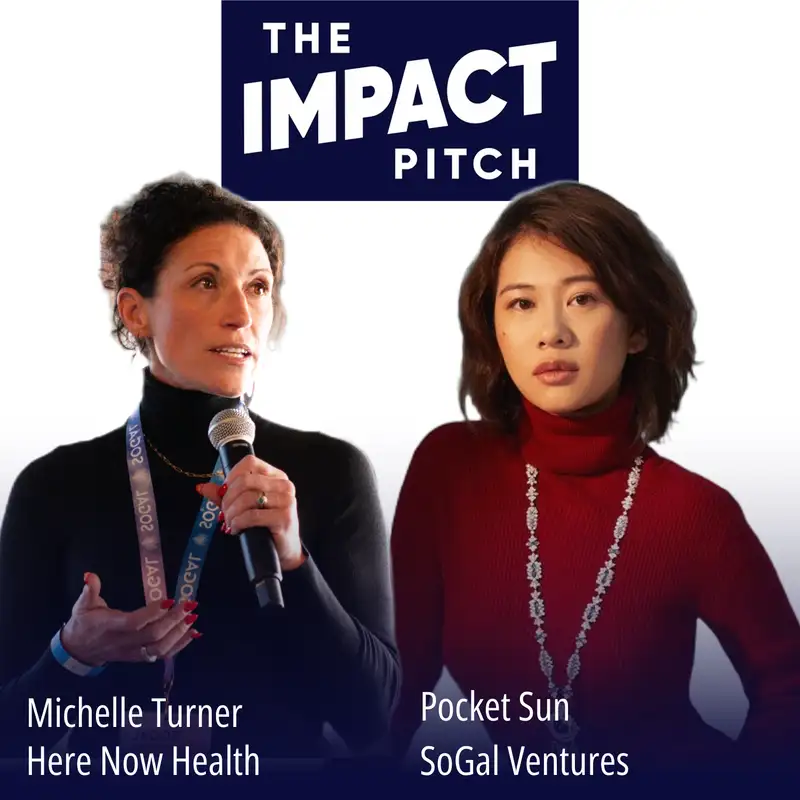
**Lee Schneider:** Welcome to the Impact Pitch podcast. I'm Lee Schneider. My first guest on today's episode is Michelle Turner, founder of Here Now Health. Our VC guest is Pocket Sun, co-founder and managing partner at Gael Ventures. We're gonna showcase a case study of how Michelle pitched her company in her early funding rounds.
Here Now Health is a virtual healthcare platform built for kids in foster care. What makes Michelle a perfect fit for this company is that she spent 15 years in digital health. She and her husband have fostered more than 40 children. Four of their six children have been adopted from foster care. She's also served as a court appointed special advocate in the foster care system.
So when she spotted a massive problem—kids with Medicaid coverage, but nowhere to get mental health treatment—she had the credibility and the inside knowledge to do something about it. Let's meet Michelle first, and then with Pocket Sun, the investor who backed Michelle's company at the pre-seed stage.
---
## Meet Michelle Turner
**Lee Schneider:** So let's start at the beginning. Why you and why this project?
**Michelle Turner:** Yeah, so Here Now Health is the first virtual healthcare company built for kids and families impacted by the foster care system. And why me and why foster care is a really good question. I've spent really my whole career in healthcare and a lot of that has been within virtual care. So I've seen the power of virtual healthcare to get high quality healthcare where it's needed most and to the individuals that need it most.
In 2013, my husband and I became foster parents in the state of Georgia. And over about five years, we fostered over 40 children, and four of our six children are adopted out of foster care. And when we closed our home to fostering, I became a CASA volunteer—or court appointed special advocate. And for about three years I volunteered advocating for system impacted families in the juvenile court system, trying to keep kids with their families, trying to get resources in the home so that kids didn't come into foster care.
And what I found Lee was that even though I was working in the healthcare system every day, I was failing over and over again to get kids in my own home the mental health care that they needed. And it wasn't a coverage issue. Kids from the moment they enter the foster care system are covered by Medicaid. It's a federal mandate. So that wasn't the issue with this population. It was almost everything else.
Kids in the foster system have about 10 times the medical spend. So we spend a lot of money, but it's almost all on crisis care. Kids end up in the emergency room, they end up hospitalized, and they end up in residential treatment many times because it's the only bed for them to sleep in.
And I knew this was not what we should be doing. And I knew it was fixable. I saw this problem. Once I saw it, I couldn't unsee it. I also knew that we could do something about it. And I had talked about it for long enough and just decided this is a company the world needs. And that is why Here Now Health exists.
**Lee Schneider:** Now there's undertow in everything that you're saying, which is your enormous credibility and experience in doing this. Would you say that kind of founder credibility is a box that has to be checked for any impact-oriented startup? It seems like you could really lean on that when approaching funders. I guess I'm asking: did you lean into that when approaching funders?
**Michelle Turner:** Yeah, I absolutely did. I think it's a really, really huge benefit. We call it oftentimes "lived experience," right? You've felt the pain of something that's not working well. It's two systems that historically have not worked well together: the foster system and the healthcare system. And I felt the pain of that. And then more importantly, I saw that pain through the eyes of a lot of kids who were getting the brunt of it. And so I absolutely leaned into this.
---
## Leaning Into Lived Experience
**Michelle Turner:** It was also a lot of education for investors—of why is this a problem? What does this look like? And where are the opportunities? I had that credibility of saying, look, I've experienced this firsthand and I've also built in the healthcare system, so I know that this is doable. I know that we can solve this problem.
And I really leaned into that during a lot of my conversations with investors, and you know, it went over really well. That's why we were able to close a round in 2025, even though we're a Medicaid startup.
**Lee Schneider:** I want to ask about how it went over in a moment. I'll come back to it. Yeah, playing through what you said when you introduced it and remembering back to the very first pitches, if you can—did you say it the way you said it to me, or is that the result of a lot of polishing?
**Michelle Turner:** So I got very good and I think I was already pretty good at sharing our personal story. The thing that I had to get better at was connecting that personal story to the investability of Here Now Health. That's the thing I had to polish and really practice. I could talk anybody that's known me for the last 10 years know I talk all day long about how we should provide better healthcare to kids impacted by the foster system. And I knew there were these cool opportunities and these interesting business drivers, but I didn't always package it in a way that was palatable to investors.
So that's the thing I had to get better at—really connecting those dots to investors who were interested and really wanted to be educated about this area, this crossover between Medicaid and child welfare. Be able to explain it to somebody who maybe had no interest or not much experience in foster care previously, and maybe not even experience in healthcare systems. To really explain how those systems work, where the opportunity is, and where this investment could go.
So yeah, I definitely had to get better in terms of connecting those dots and doing it really quickly because you don't often have much time with a brand new investor to kind of whet their appetite and get them interested.
**Lee Schneider:** Yeah, that time factor is pretty huge. And holding people's interest is also so important. What was some of the feedback you got—negative and positive—when you were first talking about this company?
---
## Pitching During Medicaid Uncertainty
**Michelle Turner:** I started pitching in spring of 2025, and if you remember, spring of 2025 was right when Medicaid cuts were starting to be really talked about and kind of put to paper for what they were going to look like. So it wasn't the ideal time to be pitching a Medicaid startup to investors.
Um, so I had to do a lot of defensive work—explaining why these potential cuts were not going to impact us and why we were different, why we were insulated from the Medicaid changes that were upcoming. So a lot of the conversations did end up gearing around questions surrounding: Are these changes going to impact us? Will this still be a viable business when these Medicaid changes come to fruition?
And so that really centered a lot of our conversations, especially when I first started talking to investors in fall.
It also gave us though a really great opportunity because the changes that were being proposed and are being implemented in Medicaid don't actually impact the population we serve, which is one of the business drivers that I knew all along, but it actually gave a really tangible way to explain what the uniqueness is. And that's because the population we serve, they are eligible not because of their parents' income. They're not eligible because of the work status of their parent. The child is eligible for Medicaid because of their own connection to the foster system. It is a federal mandate that they be covered, and that means that a hundred percent of the kids that we serve have coverage.
So it actually led to some really great conversations that were started because of fear that these changes would actually make it a worse environment for us.
**Lee Schneider:** It sounds like playing some of this back to you and reflecting some of it back that there's a real art to this. There's your background and your credibility, your lived experience, anticipating questions without being too defensive about it, and then responding after the pitch to kind of a brief Q&A. So what changes did you go through to hone all of that? I know that's a lot, but maybe that's the point. I mean, it takes a lot of ingredients to bake this cake. So how did you juggle all of those factors when honing your pitch?
---
## Investors Want to Know You
**Michelle Turner:** I realized early on that coming into these conversations, I thought I had to come into them knowing all the answers. I thought I needed to know my budget inside and out. I needed to be able to say, "You know what is in cell D17 in your budget for 2026." And I found very early that is not what investors were really honing in on. They wanted to learn about me. They wanted to learn how I was going to make decisions, how I thought through problems. We hear often that especially at the pre-seed stage, investors are investing in the founder more than they're investing in the company. They wanna know that you're not going to quit easily. They know that most of what you think right now is going to end up being wrong. That's just what happens at the early stage. But how are you going to deal with it when you realize you're wrong or when you need to pivot? When you need to shift and change?
And so that was something that I started to really learn after a few conversations—these investors really want to get to know me more than anything. They do want to get to know the problem, they want to get to know the solution that I have for it, but more than anything, they want to know how I'm going to tackle it, how I'm going to lead. And um, they want to be really confident that I'm the right person for this company.
And so I started looking at conversations much more about making sure I was offering a really open space for investors to get to know me and you know, almost any question was fine to be on the table. And really, you know, it actually made me more comfortable because I didn't feel like I had to go in knowing all the answers. I just needed to be able to be my genuine self and make them confident that I was an actual founder they wanted to invest in.
**Lee Schneider:** What specific advice did Pocket give you after hearing the pitch?
**Michelle Turner:** Um, so Pocket was a great example of somebody who was definitely looking to get to know me. Um, so Gael is not a sector-specific VC, which I love. I actually love that about them because I think it showcases even more that they were really interested in investing in me as a founder and a female founder.
Um, and so I met with Pocket during our second or third call, and I was just so impressed with how she leaned in asking about Medicaid and about foster care. It was very clear to me that Pocket wanted to very quickly learn about these very complex systems and that she was really interested and invested in the white space between welfare and foster care.
And so, um, you know, she gave me several questions that I had to kind of go away and come back with answers. But the thing that I took away from my first interaction with Pocket was I was so impressed with the detail of her questions, and it wasn't, again, it wasn't that it seemed like she was trying to trick me into not knowing answers to questions. It was that she clearly was trying to so quickly learn about an area that she maybe didn't have as much experience in so she can make a really smart decision as an investor—whether she wanted to invest in Here Now Health. I'm so grateful that she did.
**Lee Schneider:** What are the key takeaways? In other words, what is your advice for a startup founder who has an impact-oriented startup that may not be so simple to explain—it's not "Uber for blank," as the old cliche goes. So what's your advice to people getting the first ideas of a pitch together for an impact startup?
**Michelle Turner:** I would say make it uniquely yourself. The thing that was actually difficult for me when I started pitching was I had shared this idea so many times, never in the same way. So when I started pitching with a slide deck, it actually woke me up because I was going slide to slide and all of a sudden I almost felt very robotic, which is not myself. Like, I love communicating, I love talking about things I'm passionate about. And I had to actually learn how to make it a bit more systematic to make sure I was getting the information that I knew investors needed while still keeping my genuine story at the heart of my pitches.
And um, you know, I had a few not great ones at the beginning because of that. I started to go slide to slide and actually lost Michelle in the story. And so I would say to impact-focused founders, especially those who have that lived experience: center your pitch around your experience. Know, make it very uniquely you. Make sure your story shines through more than anything, and I think that is what especially impact investors want to hear.
You'll get to the numbers, you'll have subsequent meetings where they get to ask more detailed questions, but that's the thing that I think you really wanna make sure shines through, especially in that first opportunity that you have with an investor—is that you have a story to tell. You understand this because of your unique perspective. And you have a really unique solution to the problem because of that.
**Lee Schneider:** So leading with your lived experience, be yourself, and I love this—you may not have all the answers to all the questions at the beginning, and that's part of the process really.
**Michelle Turner:** Absolutely. And I found that actually, I think investors appreciated when I said I didn't have an answer, but I was going to find out. Um, you know, I could make sure they're going to—that, you know, investors have a pretty big BS factor usually. Like they can sense it, they can smell it. I found that when there was a question I didn't have an answer to, that I was going to find out and come back to them, that was appreciated more than just making something up on the spot.
And it shows confidence that you don't feel you have to have every single answer in that first call.
**Michelle Turner:** But I'll say the other thing that I learned throughout the process is not every investor is going to be right for you. And I think it's important to know that as a founder. I have a lot of factors that actually make me so that I shouldn't have been able to raise, especially in 2025. I'm a first-time founder. You know, women get less than 2% of investment as it is. I have six children. Um, moms, you know, there's a much higher bias against moms than dads in the investment process. I was raising in direct healthcare in a Medicaid market. I mean, I could just go on and on to list the reasons why I shouldn't be able to raise.
And I was able to, you know, create a cap table of investors that didn't just believe in what I was building. They didn't just believe that Medicaid is still investible and deserves innovation, but they believed in me as a founder. And so I entered some conversations where it was very clear early on that this is not an investor I'm right for them, but also they may not be right for me.
And so I think as a founder, you have to recognize that the decision is made on both sides. The investors are deciding if they're going to invest, but also you have to understand that not every investor, not every VC is a good fit, and you have to be willing to walk away if one is not.
And when it came to Segal, when it came to Pocket and Elizabeth, I didn't just love the way they were curious or wanted to dig in, but I loved that they're supporting female founders and doing it in a variety of industries. And so meeting with them, you know, it gave me that confidence that they see the difference that female founders make. They see the benefit that female founders bring, and um, and so I, you know, having them say yes was probably my biggest win of 2025.
---
## Introducing Pocket Sun
You've just heard from Michelle Turner about how she crafted her pitch, how she leaned into her lived experience as an asset during the pitch, and how she closed her first round as a first-time female founder and a mother. As Michelle mentioned, startups founded solely by women received less than 2% of venture capital funding, and VCs have been known to question a mother's commitment to their own startup.
Now, let's hear from an investor who takes a different view. Pocket Sun saw Michelle's parenting experience as a crucial asset. Pocket's venture firm, Gael Ventures, focuses on backing female founders. Pocket and I talk about how she considers founder problem fit and what she looks for beyond a pitch deck. And she shares some truths about venture math that many first-time founders are never told. Here's my interview with Pocket Sun.
---
## What Attracted Pocket to Michelle's Pitch
**Lee Schneider:** Thanks so much for joining me today on the podcast.
**Pocket Sun:** Thanks for having me.
**Lee Schneider:** What attracted you first to Michelle's pitch?
**Pocket Sun:** So the deal actually came from one of our venture fellows who was working with me last summer. When I first saw the deal, I was really drawn to how good the founder-problem fit was. Michelle is a rare combination that makes her almost like the perfect founder persona to build something in this space. And I'll explain why.
So Michelle was working in digital health and is a veteran in that space. And she herself has been a volunteer for a foster care youth support organization for a very long time. And she, in the past, she and her husband have been foster parents for 43 kids. And you can't think of a better combo than that.
So she's just innately so passionate about the problem, and she has experienced it, and she is intrinsically connected with all these stakeholders in the quite complex foster care ecosystem that involves so many different stakeholders—from the state to the MCOs, to the nonprofits, to the care facility, foster care families, to the children. So I think that kind of knowledge is very rare. And I just thought, you know, if anyone could build this, it's gotta be her.
**Lee Schneider:** I can readily see that from that impressive resume of hers that you just brought out. And this from a storytelling perspective goes to her authority in the space. Do founders encounter that as an issue when they come to you with a pitch? Is "are they the right person for this" the first thing or the second thing on your mind?
**Pocket Sun:** Yes, because I invest in the pre-seed and seed stage and at that stage there's really not much you can go off of. So why this founder? Why now? Why this problem? How is this founder going to go about it? What's the unique moat or differentiation that makes this founder, this founding team, the best people in the world to build something like this? That's definitely very crucial for the early stage.
**Lee Schneider:** When Michelle came to you, did you feel a need to adapt or change anything about her pitch? Obviously you liked her authority and background, but were there other elements that you said might need some work?
**Pocket Sun:** Yes. Yes.
---
## The Challenge for Impact Startups
**Pocket Sun:** I think when we invest in pre-seed, it's actually a very active process of working with a founder to figure out: is this a fit? Is the founder easy to work with? And can we work together on the pitch to close the round more smoothly for, you know, sometimes first-time founders?
And I think a common issue for an impact-oriented company is: Are you pitching it too small? And is this commercially viable, venture-backable, a massive scale type of company that makes a VC interested? Because this could very well be seen as impact first, but you are not getting much business upside. That's not going to work for a venture capital firm.
So that is one of the first problems that I needed to get to the bottom of with Michelle.
**Lee Schneider:** And how did that dialogue go?
---
## The Reality of Venture Math
**Pocket Sun:** So at first we talked about the exit landscape. Um, and I think Michelle's initial instinct was that she would be acquired by some of these bigger Medicaid-focused digital health companies like City Block.
But we were like, okay, if that's your end goal from the get-go, it would seem too small because City Block is worth a few billion dollars. And for you to get acquired, you'd need to be, I don't know, in the 100 to 500 million range. And if you're raising at let's say $10 million valuation, that multiple is not big enough.
Uh, it sounds very harsh to say, but you know, that's how a venture capital firm's math works. We're looking for outliers that could bring us around a hundred times return in cash, and with dilution each round, that means your valuation needs to grow. You know, if you start at 10 million, then you need to get to a billion to make it really worthwhile, because we take a portfolio approach and we need each bet to have the potential to return the fund. So that math has to work.
And I know that's something that a lot of first-time founders don't realize. So Michelle recognized the gap and started to think, okay, you know, I am pretty uniquely positioned in a very insulated space where there are very few competitors. In 17 of the 50 states, foster care healthcare is owned by single MCOs, so that means Here Now is able to win long-term contracts, usually like three to five years. And that's a very unique land grab situation that other digital health companies would very much envy.
Plus, because it's very specialized care and very few people are providing this, and there is a massive overspending problem, Here Now will be able to provide services with better margins and better negotiation power. And that has proven to be true in the states that Michelle has launched.
So with all that as context, we came to the conclusion that, well, you know, this could be a standalone, really massive company and there is a clear path for it to become a hundred million dollars in revenue. And at that point you have a lot more potential options to either acquire other care providers so that you can become the comprehensive provider platform, or you could have much better exit potential and become the dominant leader.
**Lee Schneider:** Well, you take the big picture view for these ventures and you've heard a lot of pitches and your track record is incredible. So I have to ask: is there a framework that you see when startups come to you? Are there certain storytelling checkboxes? Or is every founder, every startup different, and it's like starting over in a sense each time?
**Pocket Sun:** I would say we're really looking for founders who have clear determination to either create a brand new category, transform a category completely. It's, you know, changing people's behaviors. It's changing the patterns of how care gets delivered, how things are done, or how purchases are made. And that usually really excites us.
We really look for founders that have such a compelling vision that we couldn't help but want to be part of it for the long run. Yeah, we used to joke that my co-founder and I would have to want to chase the founder down in the rain if we have to. Because it's a long journey and you have to really like the people that you work with. And we work with our founders closely, uh, in a community, almost family-like vibe. So we want to make sure that we choose the right companions for our portfolio.
**Lee Schneider:** I love that. "Chase them down in the rain." I will remember that. It's a good image.
Thinking to Michelle again and this particular company, are there any key takeaways, any larger lessons that come to mind that would help other founders? That came about as a learning for her or for you in this experience?
**Pocket Sun:** Yes. I think the round dynamics is quite important and very rarely do founders get any education about that. So how a decision is made within a VC firm. For our firm, we just have two GPs and decisions are made between us. So that's relatively very flat, very simple. Uh, and even so, you know, decision-making could take a long time. If we can't get to an agreement or the conviction is building, but not building fast enough, you know, that process could drag on.
Same thing for a lot of other funds. And it gets more complex when there are more and more layers of investment committee decision-making process. So sometimes you're playing a tiered game where you have to convince the associates, and then the partners, and then the general partners. And each time there might be new challenges, and there might be internal politics, right?
Plus sometimes as a pre-seed company you might encounter seed stage investors who want to go a little bit upstream. Or you could encounter people who want to write a larger check than your entire round. What do you do in that situation? And you will encounter VCs who want to negotiate valuations with you to determine like what is fair and what leaves them enough room to get to their hundred times return goal or have at least a better shot at that.
So initial valuations actually do matter a lot to investors. And Here Now has another element to it, which is that Here Now was incubated by a digital health incubator. So when you have an incubator on your cap table, what percentage that incubator takes is really important. If that percentage is too big—which we have encountered before—it will make the company immediately not investible. It could seem that the founder is not correctly motivated. The cap table is not appropriately reflecting who is putting in what effort and energy in the long term and who is more deterministic of the long-term success of the company.
So when there is a mismatch or it's too messy to begin with, many VCs will pass on that. So I think Michelle did something smart in negotiating down the percentage of the incubator on her cap table, which made it not a problem. And she's a solo founder, so that means she has a lot of room to be properly incentivized as a founder. And to me, that's important.
**Lee Schneider:** Well, thanks for that enlightenment. That's pretty cool. It's another global thinking way of looking at it. Is there anything that I forgot to ask that you think should be part of this?
**Pocket Sun:** One thing I think is very important is we like to be on a journey with the founder from the get-go, even as we are evaluating. So it's very important to keep the momentum going as you are fundraising. Some founders might think, you know, when I'm fundraising, I'm just focused on fundraising and that doesn't really work, because VCs want to see that you are experiencing momentum that makes you hard to ignore.
Uh, and we like founders who give us regular updates between our calls to let us know: "Hey, you mentioned this thing and I've worked on it. Here's the result." Or, "Hey, I talked to this person per your suggestion and here's my takeaway." "Um, and the thing I said I was going to do on our first call, I am delivering the results and things are moving forward. And you know, the thing you pointed out on my financial projections? You know what? I fixed it. This is what it looks like now."
So this dynamic evolving process of working together is a snapshot of how it's going to be like when we actually work together in the long term. So it's important to see it almost like a trial period already to see, you know, whether the VC is too demanding or you actually like the suggestions they're making. You think they're adding value. So it's important to do this vibe check on both sides before you sign the papers to have a great long-term relationship with each other. It's very much that notion of people show you who they are and they show you who they are really fast. I found, you know, almost in the first meeting you get a sense of how this dynamic is going to go.
**Lee Schneider:** Well, thanks so much for joining me today on the podcast. It was really enlightening to hear from you and thanks again.
**Pocket Sun:** Yeah, thank you, Lee.
---
## Lessons Learned
**Lee Schneider:** What are the lessons learned from today's episode? Here's what sticks with me:
**Number One:** Your credibility is your superpower. Michelle's lived experience fostering, advocating for kids, and working in healthcare was the primary reason investors invested in her.
**Number Two:** Investors want to see how you think at the pre-seed stage. Investors are placing a bet on you. They wanna know how you think, how you handle failure, and whether you'll stay committed when things get difficult.
**Number Three:** The reality of venture math. If your startup can't credibly grow to a 10-plus million revenue company, most venture firms won't invest. That doesn't mean your company isn't valuable—it means it's a different kind of business and VC funding probably won't be the way you'll grow your company.
**Number Four:** As a founder, you may need to walk away from potential investors who aren't a good fit.
---
## Closing
That's it for today for the Impact Pitch Podcast. If you'd like more people to discover the podcast, go to Apple Podcasts or Spotify and please give the Impact Pitch five stars and a glowing review. I have a mailing list at impact.red/cupagency.com. I'll keep you in the loop. Thanks for listening and watching.